
No products in the cart.

The Warm Minimalist’s Guide to a Considered Living Room
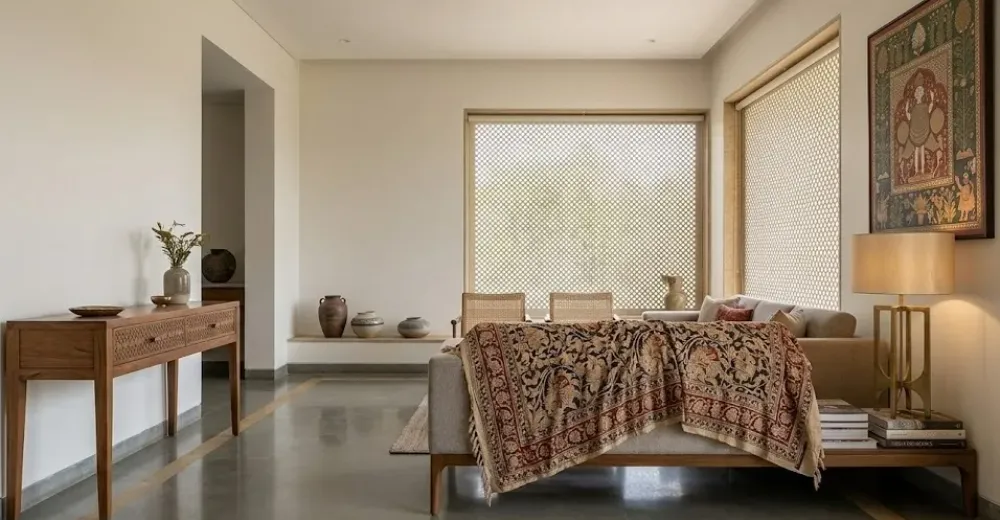
For a few years, minimalism meant mostly empty and mostly white. That version is fading. What’s replacing it across nearly every interiors forecast for 2026 is warmer, more textured, and built from natural material rather than stark surfaces, the same restraint as classic minimalism, but with actual warmth in the room instead of the feeling of an empty gallery. Here’s how to build that in an actual living room, piece by piece, colour by colour, without it turning into clutter.
What Warm Minimalism Actually Means
Warm minimalism keeps the clean lines and restraint of classic minimalism but swaps stark white and cold grey for earthy tone and visible material texture, think clay, terracotta, sage, mustard, and muted indigo, paired with wood, cane, stone, and linen. The goal isn’t emptiness. It’s a room with fewer, better objects, each one doing real work rather than sitting there as filler. Where classic minimalism often reads as withheld, warm minimalism is meant to read as settled, like a room that’s been lived in thoughtfully rather than styled just before a photograph.
The Palette, in More Detail Than ‘Earthy’
Most guides stop at the word earthy. It’s worth breaking down what that actually means in paint, fabric, and material terms, because the palette is doing more structural work in this style than colour usually does in a minimal room.
- Base neutrals: warm white, unbleached linen, and sand rather than cool white or pure grey, these form the walls and largest upholstered pieces
- Grounding tones: terracotta and rust, used on one or two larger objects, a lamp base or a floor vessel, rather than spread across many small ones
- Accent tones: sage green and muted mustard, best kept to textiles, a cushion cover or a throw, where they’re easy to change out later
- A single deep note: indigo or charcoal, used sparingly to stop the palette from feeling flat, often through a single textile or piece of wall art rather than furniture
A simple rule that holds up well in practice: one base tone across the largest surfaces, one grounding tone in a single anchor object, and no more than two accent tones in soft furnishings that can be swapped seasonally without touching the furniture underneath.
Seating and Rugs: Where Most Rooms Get It Wrong
Warm minimalism lives or dies on the seating, because it’s the largest surface in the room and the easiest place for the wrong material to undo everything else. Boucle, linen, and heavy cotton weaves hold the warmth this style depends on, where glossy synthetic upholstery or anything with a cool, slick finish tends to fight against it, no matter how well the smaller objects are chosen.
Underfoot, a flat-weave natural fibre rug, cotton or wool dhurrie-style weaves are the classic Indian expression of this, does more for a room’s warmth than an equivalent budget spent on decorative objects. It grounds a seating area the way a good rug always has, but a natural, low-pile weave keeps it in step with the material honesty the rest of the room is built on, rather than introducing a synthetic sheen underfoot.

Lighting: Layered, Not Just Overhead
A single ceiling light rarely creates warmth on its own. Layering a cotton voile pendant lamp with a terracotta lamp base on a side table gives the room two different qualities of light, one ambient and diffused, one warmer and closer to eye level, which does far more for the room’s mood than a single bright source ever will. A third, smaller source, a low accent light near a reading chair, is what separates a room that feels layered from one that simply has a lamp in it.
Texture on the Floor and the Surfaces
A handwoven basket from the Baskets collection does double duty here, genuine storage and genuine texture at floor level, a spot most living rooms otherwise leave flat and untextured. Grouping two baskets at slightly different heights beside a sofa reads as considerably more intentional than a single piece on its own, and it echoes the same natural-fibre logic as the rug beneath it.
Soft Textiles, Chosen for Texture Over Print
Cushion covers do a lot of the warmth-building work in this style. Handwoven weaves like the Anika Taupe Naga Handwoven 100% Cotton Cushion Cover or the Apurva Ivory Handwoven Cotton Cushion Cover read as texture first and pattern second, which fits the warm minimalist palette better than a bold print would. A throw folded over the arm of a sofa, rather than draped flat across the back, adds the same textural weight in a way that still looks used rather than staged.

Walls and Art: The Most Skipped Step
A warm, textured room with bare walls still reads as unfinished. This is the step most people leave out, mainly because it feels harder to get right than a cushion or a basket. A single piece of handwoven textile art, like the Kshetra Grey Handwoven / Kantha Embroidered Cotton Silk Textile Art, does more for a warm minimalist room than a gallery wall of smaller prints, because it carries the same handcrafted, textured quality as everything else in the space rather than introducing a flat, printed surface. One considered piece, hung at seated eye level above a console or sofa, is usually enough.
Common Mistakes That Undercut the Look
- Using too many accent colours at once, three or four competing earth tones read as busy rather than warm, stick to the one-base, one-anchor, two-accent structure above
- Mixing in a few glossy, mass-produced pieces, a single laminate or high-shine object next to handwoven textiles breaks the material honesty the whole room depends on
- Overcrowding surfaces, warm minimalism still relies on restraint, a coffee table with one considered object reads better than one with five small ones
- Lighting the room in cool white bulbs, which flattens every warm tone in the palette regardless of how well the materials were chosen
- Leaving walls bare while over-styling the floor and surfaces, an unfinished wall undercuts a room that’s otherwise been carefully put together
A Simple Order to Build It In
Warm minimalism rewards patience more than a single large purchase, and it tends to look more convincing when it’s assembled in a deliberate order rather than all at once:
- Settle the base tone first, walls, largest upholstery, and flooring, before buying a single decorative object
- Anchor the seating area with a natural-fibre rug and upholstery in linen, boucle, or heavy cotton
- Layer the lighting, an overhead or pendant source plus at least one lamp at a lower, warmer height
- Add floor texture with a basket or grouped pair, positioned beside seating rather than floating in open space
- Bring in soft textiles last, cushion covers and a throw, since these are the easiest and cheapest pieces to change later
- Finish the walls with one considered textile or art piece, rather than several smaller prints
A Few Honest Questions
Is warm minimalism just beige minimalism with a new name?
Not quite. The palette is warmer, but the bigger shift is material, natural fibre, stone, terracotta, and visible handwork replacing flat, uniform surfaces. Colour is only part of it.
Can a small living room still do this style, or does it need space?
It works especially well in smaller rooms, since the style depends on a few considered pieces rather than filling space with volume. A single rug, one basket pair, and layered lighting can transform a small room more convincingly than a large one, precisely because there’s less competing for attention.
How many natural-material pieces does a room actually need?
Fewer than you’d think. A lamp, a basket, a textured cushion cover or two, and one wall piece is often enough to shift a room from stark to warm without it looking overdone.
What’s the fastest way to make a room feel warmer without buying anything new?
Swap any cool white bulbs for warm white, and move existing textiles, a cushion, a throw, so they’re layered rather than perfectly symmetrical. Both cost nothing and shift the mood of a room within an afternoon.
Building It Slowly
Warm minimalism rewards patience more than a big single purchase. Adding one considered, natural-material piece at a time, a lamp this month, a basket the next, tends to build a more convincing room than trying to complete the look all at once.
Explore the Baskets, Pendant Lamps, Lamp Bases, and Textile Art collections to start building the room piece by piece.


Leave a Reply