
No products in the cart.

The Hands Behind Every Black Stone Bowl Nimmit Makes
Every piece in Nimmit’s black stone pottery collection passes through the same sequence. Stone is pounded into powder. Powder is mixed with water and kneaded into a dense dough for hours. That dough is shaped entirely by hand, dried slowly, fired at high heat, and polished with leaves from a local plant. At no point in this process does a machine make a decision.
This is not a romantic description of craft. It is the literal process, unchanged in its fundamentals for generations, still practised by the Tangkhul Naga community in the Ukhrul district of Manipur. The people who shape these bowls do not use a potter’s wheel. They work from knowledge that lives in the hands, not in a diagram or a manual.
What the Stone Actually Is
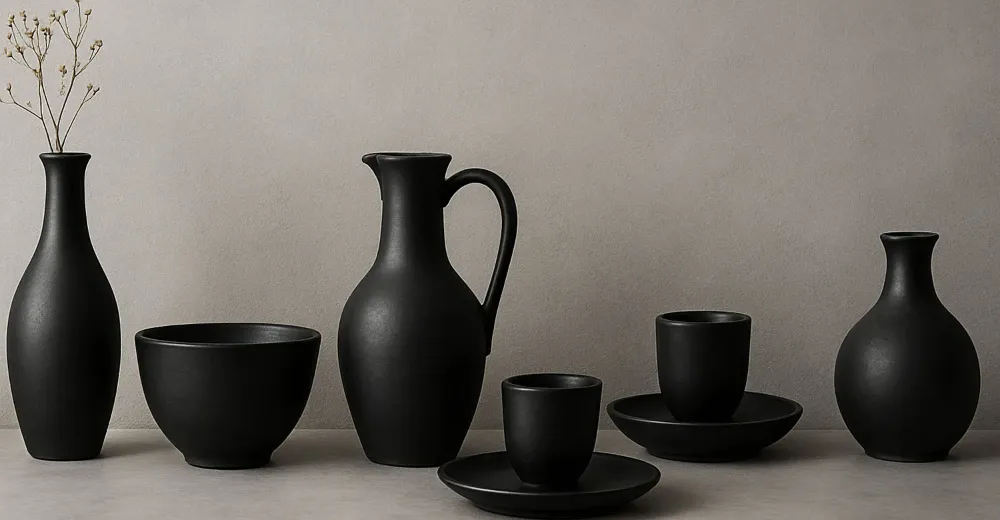
The material itself is worth understanding, because it is not clay in the usual sense. Longpi pottery is made from two rocks found in the hills near the Longpi villages: serpentinite, a dark stone that gives the finished piece its weight and density, and a softer weathered rock that acts as a binding agent. Neither can make a pot alone. Mixed in the right proportion with water and kneaded until pliable, they produce a material that can be coaxed into shape by hand and that survives firing at temperatures well above 900 degrees.
The result is something quite different from conventional ceramic. Heavier, more inert, better at holding temperature. A bowl that can carry hot food to the table and still feel warm to the touch twenty minutes later.

The Part That Cannot Be Taught Quickly
Shaping is where the knowledge lives. Without a wheel to govern symmetry, the consistency of a finished piece depends entirely on what the artisan has learned through repetition. The wall thickness of a bowl, the curve of its rim, the point at which the base becomes steady without being too heavy all of this is managed by hand, by feel, refined over years of practice.
Both men and women work the craft in Longpi. The community’s technical knowledge is distributed, not concentrated in a single master. Pieces come out with subtle differences from one artisan to the next, which is precisely why no two bowls in the collection are identical. The variation is not inconsistency. It is evidence of who made the piece and how.
The Firing and What Comes After
Once shaped and thoroughly dried, the pieces go into a kiln. The firing lasts several hours. At temperatures above 900 degrees, the stone mixture vitrifies, becoming dense, hard, and permanently black. No paint, no coating, no stain is involved. The black is intrinsic to the material and the process.
When pieces come out of the kiln, still hot, artisans polish them immediately with leaves from a local creeper. This final step is what gives the surface its subtle sheen without making it shiny in the way glaze does. The result is a surface that absorbs light rather than reflecting it, which is much of why these pieces sit so quietly in a modern interior.

Why Nimmit Works This Way
Manish Shah, who founded Nimmit as a second-generation textile entrepreneur, has said plainly that the brand believes luxury lies in intention, not excess. The black stone pottery collection is a direct extension of that position. Each piece carries the marks of the artisan’s hand and the time it took to create it. That time is not inefficiency. It is the whole point.
Nimmit’s model with its artisan communities is built around long-term collaboration, not one-off manufacturing. The pottery collection follows the same approach as the brand’s textile work, where the relationship with the maker is ongoing and the artisan’s skill is treated as something worth protecting rather than extracting.
| Nimmit works closely with artisan communities across India through long-term collaboration, fair value practices, and skill development. Each creation reflects a shared journey of heritage, care, and craftsmanship. |
When you hold a Nimmit bowl and notice that the curve is slightly different from the one next to it, that difference has a name. It is the name of whoever shaped it.
A Craft That Hasn’t Needed to Change
The process that produces these bowls has not changed because nothing about it needs to change. The stone is still found in the same hills. The firing still works the same way. The hands are still the most precise instrument involved.
That’s not a marketing claim, it’s simply what happens when a craft was already resolved centuries before anyone thought to modernise it. Nimmit’s role isn’t to improve on the process. It’s to make sure it keeps reaching homes that will actually use and appreciate it.
A Honest Questions
Is this the same as other black pottery I might have seen?
Not necessarily. Black pottery is made in a few different parts of India using genuinely different techniques, some using smoke-firing on clay, others, like this Longpi tradition from Manipur, using ground stone and a wood-fired kiln with no smoke-blackening at all. The colour, texture, and care needs differ depending on which one you have.
Cherished, Not Just Crafted
This pottery is not merely made. It’s shaped, dried, fired, and finally, lived with. In a home built around considered, honest materials, that’s exactly the role it’s meant to play.
See the full Bowls collection, or read our Marble vs Black Stone buyer’s guide if you’re deciding between the two.


Leave a Reply