
No products in the cart.

Marble vs Black Stone: A Buyer’s Guide to Indian Stone Serveware
Two materials keep showing up in the same conversation whenever someone starts building a table setting that feels chosen rather than collected: marble, cool and quietly veined, and black stone pottery, matte and warm under the hand. Both read as understated luxury. Both come from centuries-old Indian stone traditions. And most people comparing them are doing it on looks alone, without knowing what actually separates one from the other.
This guide is for the buyer who wants more than a photograph before deciding what lands on their table. Origin, process, food safety, care, and how each one actually behaves in daily use.
What Black Stone Pottery Really Is
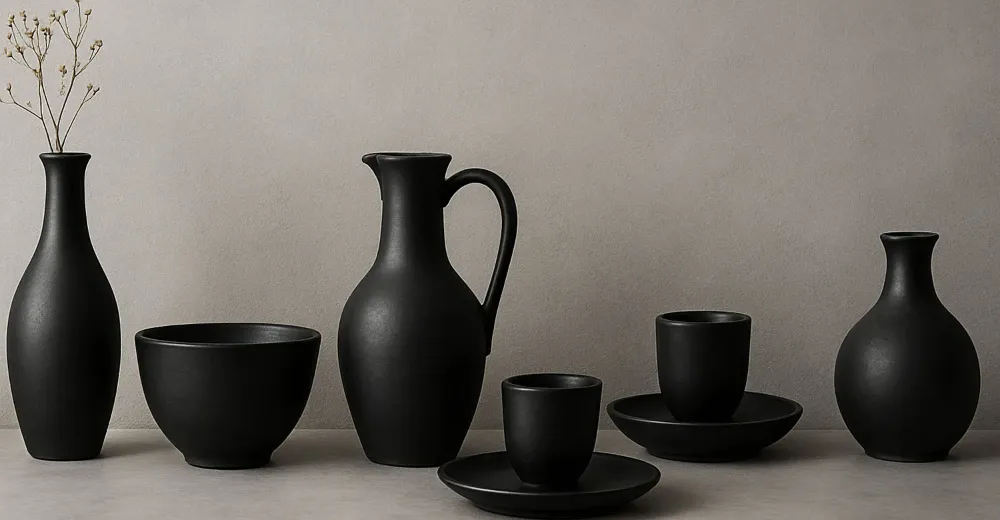
Black stone pottery comes from Longpi, two villages in the Ukhrul district of Manipur, in India’s northeast. The Tangkhul Naga community has practised it for generations, and the process has nothing in common with a potter’s wheel. Artisans grind black serpentine stone and a weathered local rock into powder, mix it with water into a workable paste, and shape it entirely by hand, supporting the inside of the vessel with a rounded stone while beating it into form from the outside.
Once shaped and sun dried, the pieces are fired at high temperature, often close to 1,000 degrees Celsius. The black colour is not a glaze or a pigment. It comes from the stone itself and from the firing process, which is why the surface has a slight variation from piece to piece rather than a uniform factory finish.
It’s worth being precise here, because black stone pottery is sometimes confused with other Indian metal and clay crafts that share a dark finish, like Bidri ware from the Deccan region. Longpi pottery is a stone and clay tradition unique to Manipur, and that distinction matters if you’re researching provenance before you buy.
What Marble Serveware Brings to a Modern Table
Marble is a different material altogether. It’s a metamorphic rock, quarried in blocks and then carved by hand, not built up from clay. Where black stone pottery is additive (an artisan builds a form from a paste), marble carving is subtractive: the artisan works down from a solid block until a bowl, chopping board, or container emerges from the stone.
Every piece carries the natural veining of the slab it came from, so no two bowls are identical. That’s part of the appeal for a Mindful Modernist home. It looks engineered but it’s entirely handmade.

Two Crafts, Two Very Different Disciplines
Set side by side on a table, marble and black stone pottery can look like they belong to the same design language: both minimal, both monochrome, both quietly sculptural. But the hands behind them are doing completely different work. One is building a form out of stone paste, patient and additive. The other is removing stone until a form appears, patient and subtractive. Knowing this changes how you look at either piece. What reads as a simple bowl is actually the result of two entirely separate crafts arriving at a similar aesthetic from opposite directions.
Food Safety and Everyday Use
This is usually the deciding question, so it deserves a straight answer rather than a marketing one.
Longpi black stone pottery has a long history of direct use for cooking and food storage in Manipur. Because it carries no added glaze, pigment, or chemical coating, it’s widely described by artisans and craft researchers as non-reactive and safe for slow cooking over a low flame. Locals use it for dishes that benefit from long, gentle heat.
Marble behaves differently. It’s porous and reacts to acid, which means anything with lemon, vinegar, tomato, or wine left sitting on the surface for a while can leave a dull mark called an etch. This isn’t a defect. It’s simply the nature of a calcite-based stone. Marble serveware is best suited to dry or brief-contact food: bread, cheese, fruit, nuts, or as a short-term serving vessel rather than a place to marinate or store acidic leftovers.
Care That Actually Keeps Them Beautiful
Black stone pottery asks for very little. A wipe with warm water is usually enough, and it’s best to avoid harsh detergents that can dull the natural sheen the firing process gives it. Sudden temperature shocks, like pouring cold water into a piece straight off the stove, are worth avoiding on any stoneware.
Marble needs a bit more attention. Hand wash rather than machine wash, dry it immediately rather than letting water sit, and skip vinegar-based or citrus cleaners entirely. Larger marble pieces benefit from occasional resealing, though this matters less for smaller hand-carved bowls than it does for countertop-scale marble.

How Each One Sits in a Minimal Room
Marble brings a cool, architectural quality to a table. Its pale tones and subtle veining pair naturally with brass, linen, and pale wood, and it tends to photograph beautifully in the kind of soft, north-facing light that Kinfolk-style interiors favour.
Black stone pottery does something different. Its deep matte black and slightly irregular hand-shaped edges give a table weight, the way a well-chosen piece of furniture grounds a room. It sits comfortably next to natural fibre runners, unglazed ceramics, and warm wood tones, and it reads as intentional rather than decorative.
Which One Actually Fits Your Table
If you’re looking for pieces you’ll use for actual meals on a regular basis, black stone pottery’s cooking and serving heritage makes it the more natural fit. The Anura Black Stone Pottery Bowl or the Angee Black Stone Pottery Dinner Plate both work as everyday serveware with a story behind them.
If you’re after a styling anchor, a fruit bowl, a catch-all for the console table, or a board for bread and cheese, marble tends to win. The Indra Black Hand Carved Marble Bowl and the Laksh Black Hand Carved Marble Chopping Board both do quiet, sculptural work on a counter or table even when they aren’t in active use.
Most Mindful Modernist homes end up with both. One for the meals that actually happen at the table. One for the moments the table sits waiting to be admired.

A Few Honest Questions
Is black stone pottery safe to cook in?
Traditionally, yes. Longpi black stone pottery has been used for direct cooking and slow simmering in Manipur for generations, and it carries no glaze or chemical coating. For Nimmit’s own range specifically, check the product page or ask us before using a piece on direct heat, since not every shape is made for stovetop use.
Does marble serveware need sealing?
Larger marble surfaces benefit from occasional resealing to resist staining, though this matters far less for smaller hand-carved bowls and boards. What matters more day to day is wiping up anything acidic, like citrus or wine, before it has time to etch the surface.
Which is heavier, marble or black stone pottery?
Marble is the denser of the two and will generally feel heavier for a similarly sized piece. Black stone pottery is surprisingly light for something made of stone, which is one reason it travelled so easily as everyday cookware in Manipuri households.
Can I put either one in the dishwasher?
We’d recommend hand washing both to protect their natural finish over time, even where a piece is described as dishwasher safe. It’s a small habit that keeps the surface, and the story behind it, looking the way it did on day one.
Living With Both
Choosing between marble and black stone pottery isn’t really about picking a winner. They come from different parts of India, different hands, different centuries-old techniques, and they ask different things of the people who use them. A table that holds both is a table that understands what conscious craft actually means: not one aesthetic applied everywhere, but a collection of honest materials, each doing what it does best.
Curious where black stone pottery came from before it reached your table? Read the full story of Longpi craftsmanship here.
Leave a Reply