No products in the cart.
Styling Handwoven Cushion Covers for the Modern Indian Living Room (2026 Guide)
Your sofa is the largest, most-lived-with surface in your home. What you put on it particularly the cushion covers; shapes the entire personality of your living room. In an age when most homes are decorated from the same five online catalogues, a set of handwoven cushion covers is one of the most powerful ways to make a space that is unmistakably, quietly yours.
This guide is for anyone who wants to style their Indian living room with handwoven cushion covers in a way that feels considered and enduring, not seasonal, not trend-chasing, not assembled in an afternoon and replaced in six months.
Why Handwoven Cushion Covers Change a Room
Walk into a room with machine-printed cushion covers and you will feel a certain flatness to it, everything looks correct but nothing compels you to sit down. Walk into a room with handwoven cushion covers and you feel something different: texture, depth, warmth, a quality of presence that is hard to name but immediately felt.
This is not accidental. Handwoven fabrics; whether Tangaliya, Ikat, Naga, or any of India’s other extraordinary weaving traditions, have an irregular, organic structure that the eye reads as alive. Light falls across a handwoven surface differently at different times of day. The slight variations in tension, the thickness of individual threads, the colour shifts across a woven gradient, none of this is noise. It is exactly what makes a room feel inhabited rather than staged.
For the modern Indian living room, which increasingly navigates between heritage and contemporary aesthetics, handwoven cushion covers are the ideal bridge. They carry cultural depth without heaviness, visual interest without clutter, and they age gracefully rather than dating.
Understanding the Weaves – What You’re Working With
Before styling, it helps to understand what makes each weaving tradition distinct. Nimmit’s cushion cover collection draws from several of India’s finest craft lineages.
Tangaliya Weave – Gujarat’s Hidden Gem
Tangaliya is a GI-tagged craft from Surendranagar, Gujarat, traditionally practiced by the Dangasia community. It is characterised by tiny dots or raised motifs formed by extra weft threads, a painstaking technique that creates a distinctive dotted surface with remarkable tactile depth. In a living room, Tangaliya cushion covers (such as the Gagan Teal from Nimmit’s collection) bring a quiet complexity, subtle at a distance, extraordinary up close. They work beautifully against plain or textured sofas.
Ikat – Pattern Made Before the Weave
Ikat is a dyeing technique in which threads are resist-dyed before weaving, creating patterns with characteristic soft-edged, slightly blurred borders. The Ara Sage Green Ikat from Nimmit is a good example: the colour bleeds gently at its edges, giving the pattern a warmth that sharp-edged prints do not have. Ikat cushion covers are exceptionally versatile, they work in both traditional and contemporary settings because their pattern reads as both ancient and graphic.
Naga Handweaving – Textile from the Northeast
Naga textiles from India’s Northeast are characterised by bold geometric patterns, strong colour contrasts, and a striped structure woven into the fabric itself. Unlike printed or embroidered cushion covers, Naga-woven covers have pattern and structure as a single entity, you cannot separate the design from the cloth, because they are the same thing. In a living room, a Naga-woven cushion cover is the piece that does not ask for permission. It anchors the arrangement.
The Modern Indian Living Room – What It Looks Like in 2026
Indian living rooms in 2026 are moving towards a quieter confidence. The maximalist layering of the early 2010s has given way to a more considered aesthetic: fewer objects, more meaning; fewer patterns competing, more one strong textile statement. Natural materials – wood, terracotta, cotton, cane are favoured over synthetic finishes. Colour is used purposefully rather than prolifically.
In this context, handwoven cushion covers are not a nostalgic addition. They are the natural choice because they are exactly what this aesthetic calls for: natural material, visible craft, enduring beauty, and cultural rootedness expressed without self-consciousness.
How to Style Handwoven Cushion Covers – A Room-by-Room Guide
Styling is not decorating. Decorating is filling a space. Styling is composing one. Here are the principles that make handwoven cushion cover arrangements work, with specific guidance for different living room types.
Rule 1 – Anchor with Texture, Punctuate with Colour
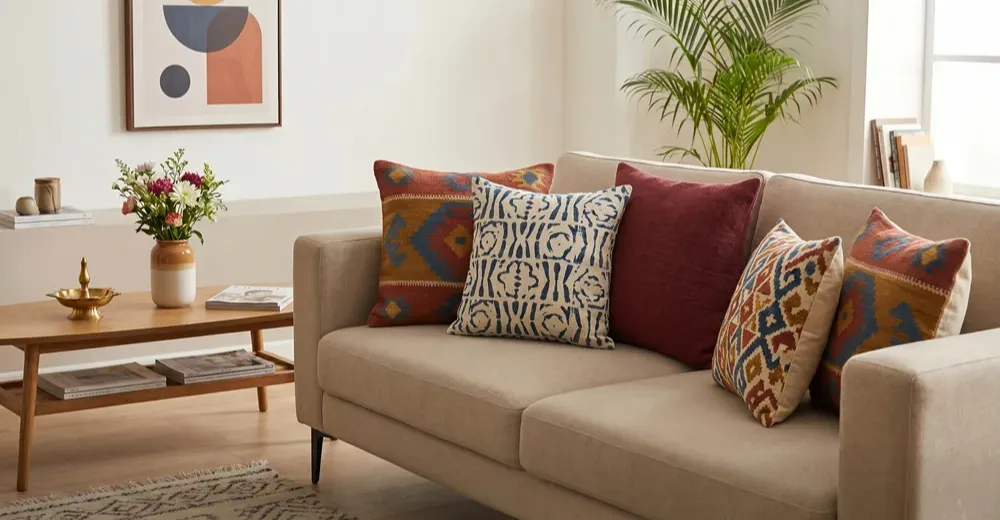
Start with the textile that has the most visual weight, often a Naga-woven stripe or a bold Ikat and build around it. Place this piece at the centre or as a pair flanking the sofa. Then add two smaller cushion covers in a tonal or complementary colour without competing pattern. A Tangaliya cushion in teal against a neutral Ikat in sand, for example, creates depth without discord. The handwoven texture across both pieces provides unity even when the patterns differ.
Rule 2 – Odd Numbers, Mixed Sizes
Three or five cushions almost always look better than two or four. The odd number creates a composition rather than a symmetrical arrangement and compositions read as curated rather than placed. Mix a larger 24-inch cushion with standard 18-inch covers and a smaller 14-inch accent. The size variation creates depth on a flat sofa surface.
Rule 3 – Let the Weave Be Seen
One of the most common mistakes with handwoven cushion covers is over-accessorising around them. Let the textile breathe. A Tangaliya cover in teal on a natural linen sofa needs nothing else to make a statement not a throw, not a rug, not a side table arrangement. The weave itself is the décor. Restraint is the hallmark of a well-styled Indian living room.
Rule 4 – Pair Cushions with Room Materials, Not Just Colours
Handwoven cushion covers look most at home when the materials around them echo their materiality. A cotton Ikat cushion is at its best on a cotton or linen sofa, against a bare plaster wall, beside a terracotta lamp base. It looks strained on a velvet or faux-leather sofa, or in front of a glossy feature wall. Consider the material conversation your room is having, and make sure the cushion covers join the right one.
Colour Palette Guide – Which Handwoven Covers Work Where
The palette of handwoven textiles is inherently different from printed or dyed solid covers. Woven colours have depth they shift slightly in different light because they are created by layering coloured threads rather than coating a surface. This means a teal Tangaliya in the morning is slightly different from the same teal in evening lamplight. Work with this, not against it.
- Teal and indigo woven covers: Best against cream, off-white, natural wood, or terracotta surrounds. They anchor without overwhelming.
- Sand, ochre and ecru weaves: Universally versatile. They read warm in any light and work with both cool-toned (stone, slate) and warm-toned (wood, brass) interiors.
- Bold Naga geometrics in red/black or blue/ivory: Use as the single statement piece. One, maximum two, in an arrangement. Do not cluster them, their power is in isolation.
- Multi-coloured patchwork or Kantha covers: These are the wildcard of the collection. They work best in rooms that already have a strong natural-material foundation, where the colour reads as warmth rather than chaos.
Common Mistakes to Avoid When Styling Cushion Covers
- Matching everything: A living room where every cushion matches the curtains which match the wall which matches the rug is a catalogue page, not a home. Allow some tension.
- Too many patterns at the same scale: Mix scales, one large-repeat weave with a fine-textured Tangaliya and a solid natural cover.
- Ignoring the sofa itself: The sofa’s material and colour are part of the composition. A handwoven cover on the wrong base can fight rather than complement.
- Seasonal swapping for its own sake: Handwoven covers are not seasonal accessories. A well-chosen set should live in your room year-round and become part of its identity.
Shop Nimmit’s Handwoven Cushion Covers for the Indian Living Room
Nimmit’s cushion cover collection includes pieces woven in Tangaliya, Ikat, and Naga traditions by skilled artisans across India. Each cover is named, limited in stock, and made in the kind of quantities that mean the piece you choose is unlikely to be found in anyone else’s living room.
Browse the full cushion covers collection at nimmit.in/product-category/living/cushion-covers/
FAQ Section
Q1: What is the best size for cushion covers on a large sofa?
A: For a standard three-seater sofa, a combination of 24-inch and 18-inch covers works best. Mix sizes for depth- avoid all same-size arrangements, which look flat.
Q2: How do I wash handwoven cotton cushion covers?
A: Hand wash in cool water with mild detergent, or machine wash on a gentle cycle. Air dry flat or line dry in the shade. Avoid tumble drying and high heat, which can cause shrinkage and affect the woven structure.
Q3: How many cushion covers do I need for a three-seater sofa?
A: Three to five is the ideal range. Three creates a clean, composed look; five allows for more layering and texture. Avoid even numbers, which tend to look arranged rather than natural.
Q4: What is Tangaliya weave?
A: Tangaliya is a GI-tagged handweaving tradition from Surendranagar, Gujarat, characterised by raised dot motifs created by extra weft threads. It is one of India’s rarest and most distinctive textile crafts.
Q5: Can handwoven cushion covers be used outdoors?
A: Handwoven cotton covers are best used indoors. Cotton is susceptible to fading in prolonged direct sunlight and damage from moisture. For shaded outdoor spaces, bring covers inside when not in use.