No products in the cart.
Moving Beyond Trends: Building a Timeless Indian Home in 2026
Somewhere between the third time you repainted your living room in the last five years and the moment you realised the ‘statement piece’ you bought last Diwali had somehow become dated by Christmas, a question quietly forms: is there another way to do this?
There is. It is not new. It is, in fact, very old, and that is precisely the point.
Building a timeless Indian home is not about following a different set of rules. It is about understanding why certain objects, materials, and arrangements endure while others do not, and choosing accordingly. This guide is for people who want to stop redecorating and start inhabiting.
Why Trends Are the Wrong Starting Point for an Indian Home
The trend cycle in home décor has accelerated dramatically. What was ‘in’ on Instagram in early 2024 was already being described as overdone by late 2025. Arched mirrors, limewash walls, bouclé sofas, rattan everything each had its moment and is already carrying the weight of its own overexposure.
The problem is not with any individual aesthetic. The problem is with the model of decoration: the idea that a home should reflect what is currently popular rather than who actually lives in it.
Indian homes have a different inheritance. India’s craft traditions weaving, pottery, metalwork, basketry are not seasonal. A Kantha-stitched quilt is not of its era; it is of its maker. A terracotta lamp base does not reference a trend; it references ten thousand years of material knowledge. These objects do not date because they were never trying to be current. They were trying to be well-made.
This is the foundation of building a timeless Indian home: choosing objects whose value comes from craft and material quality, not from cultural moment.
The Principles of Timeless Indian Interior Design
Principle 1 – Choose Natural Materials and Let Them Age
Synthetic materials are dishonest in one particular way: they pretend to be something they are not, and when the pretence fails when the faux leather peels, the synthetic weave pills, the plastic coating chips, there is nothing underneath. Natural materials; cotton, terracotta, wood, cane, stone- do not pretend. They are themselves, completely and at every stage of their life. They age into themselves rather than degrading from a peak.
A handwoven cotton throw gets softer. A terracotta lamp base develops a gentle patina. A rattan pendant lamp frame acquires a slightly deeper tone over time. These are not flaws; they are the home accumulating character. Choose natural materials not as a trend but as a commitment to objects that you can live with honestly.
Principle 2 – Invest in Fewer, Better Things
The most common design mistake in Indian homes, particularly as disposable home décor has become more accessible, is accumulation. Objects that were bought on impulse, that served a seasonal decoration purpose, that seemed like a good idea in the moment, now crowd shelves and surfaces and make every room feel slightly exhausted.
The alternative is not minimalism, which can feel cold and effortful in the Indian context. It is selectivity: buying fewer things, but choosing each one for its craft quality, its material honesty, and its capacity to belong in the room for years. A set of three handwoven cushion covers chosen with care will outlast, in visual impact and physical quality, twelve machine-printed covers bought at speed.
Principle 3 – Build Around Craft, Not Colour
Colour trends are the most perishable element of interior design. The colour of the year becomes the colour of last year within eighteen months. Craft does not work this way. A piece made well, from good material, by a skilled artisan, with a considered form, transcends its colour palette because its value is structural, not cosmetic.
When building a timeless Indian home, choose your objects for their craft quality first. A Kantha-stitched quilt in indigo and ivory will outlast the indigo as the fashionable colour; you will still want it in the room when indigo has cycled out because the stitching is beautiful in itself.
Principle 4 – Root Your Home in a Specific Tradition
India has more craft traditions per square kilometre than almost any other country on earth. The mistake is to try to represent all of them simultaneously. A room that contains Rajasthani block print, Kashmiri embroidery, Banarasi brocade, and Madhubani wall art in equal measure does not feel richly Indian, it feels like a craft fair.
A more considered approach is to root your home in one or two specific traditions and develop depth in those. Tangaliya weaves from Gujarat and terracotta pottery from Rajasthan share a language of earthen tones, natural materials, and tactile surfaces that speak to each other beautifully. Naga textiles from the Northeast and bamboo from the same region create a coherent dialogue of bold pattern and natural structure. Find your traditions and follow them with intention.
Building a Timeless Indian Living Room
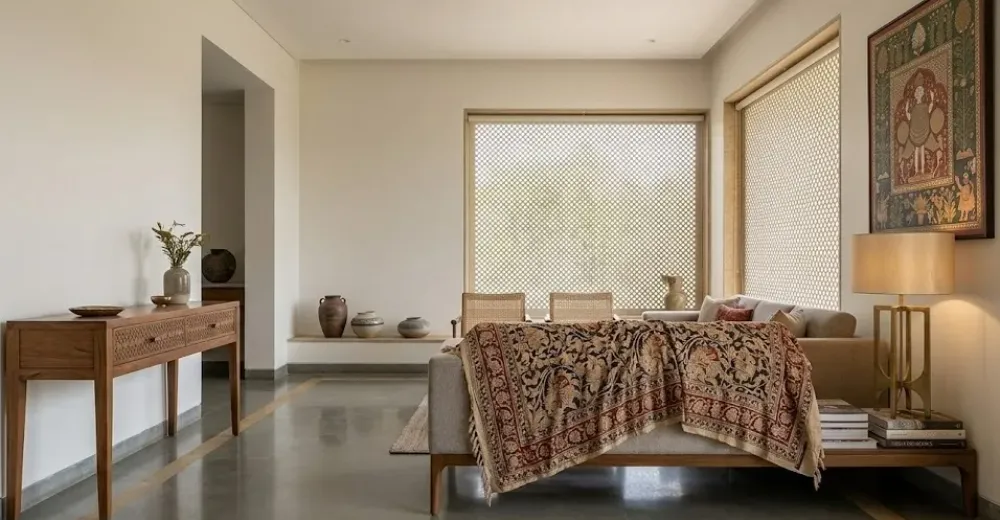
The living room is where most decoration decisions are made and most decoration mistakes are most visible. Here is how to build one that does not need to be redone in three years.
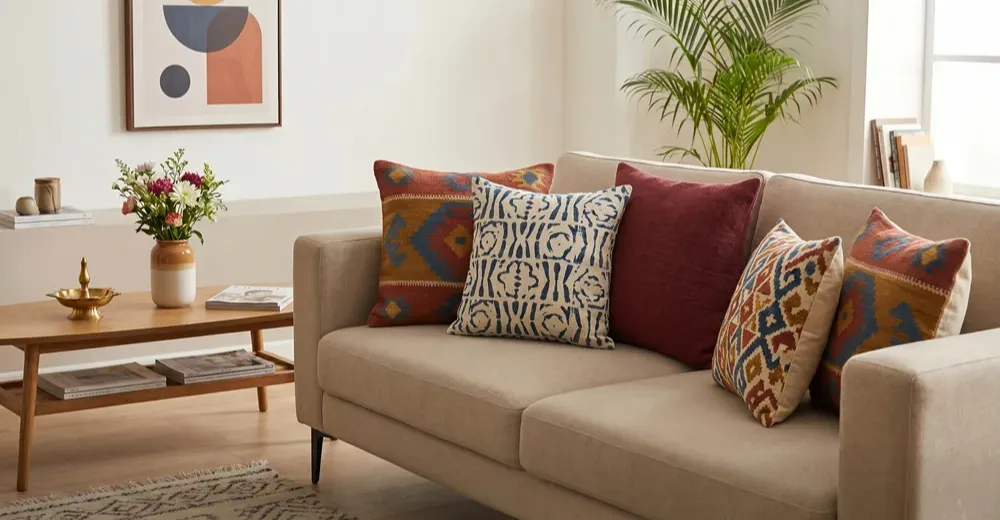
- The sofa: Choose a natural material upholstery – linen, cotton, or wool, in a tone that is not trying to make a statement. The sofa is the canvas; the textiles on it are the painting.
- Cushion covers: Invest in handwoven covers from India’s craft traditions. Tangaliya, Ikat, Naga, or embroidered cotton, choose two or three traditions that work together and stay with them. These covers should last years, not seasons.
- Throws and textiles: A handwoven Naga or Ikat cotton throw adds warmth and layering without imposing a colour story. Keep it folded over the arm or the back of the sofa, it works as both object and textile.
- Lighting: A pendant lamp with a printed cotton voile shade and a cane frame, or a terracotta table lamp base, these are the lighting choices that age into a room rather than dating it.
- Storage and vessels: Handwoven baskets, terracotta planters, and artisan boxes give the living room utility with craft at its centre. They are the room’s working objects and its décor simultaneously.
Building a Timeless Indian Bedroom
The bedroom is the room in which craft and comfort must work hardest together.
- Quilts: A Kantha-stitched or patchwork cotton quilt is among the most enduring investments you can make for a bedroom. It is a functional object and a piece of textile art that improves with use and age.
- Bed linen: Handwoven cotton bed linen breathes, softens with washing, and carries none of the chemical finishes of mass-produced sheets. Choose natural tones that work across seasons.
- Lamp base and shade: A terracotta or stoneware lamp base beside the bed, with a natural fabric shade, produces the warm, diffuse light that a bedroom needs and does so with materials that will be as beautiful in ten years as they are today.
- Minimal surfaces: The bedroom is not the place for accumulated objects. A single handcrafted piece, a decorative box, a small terracotta vase, a handmade oil lamp for evening puja is more powerful than a shelf of things.
What to Avoid – The Anti-Checklist for Timeless Design
- Avoid: Hyper-specific colour trends (terracotta has been ‘the colour’ three times in the last decade). Choose terracotta for the material, not the moment.
- Avoid: Objects with no maker behind them. If you cannot trace an object to a craft tradition or a making process, it is unlikely to carry the kind of presence that makes a room feel enduring.
- Avoid: Matching sets. A bedroom where everything is from the same collection photographed in the same studio looks exactly like a hotel room. Let things find each other from different makers and different traditions.
- Avoid: Decoration for its own sake. Every object in a timeless home should justify its space — through beauty, through utility, or through the story it carries. If it does none of these, it is clutter with better lighting.
Nimmit and Timeless Design – Why We Build This Way
At Nimmit, we do not follow home décor trends. It is simply that the objects we make and source are not trying to be of the moment. They are trying to be well-made. A Tangaliya cushion cover, a handwoven bath towel, a terracotta lamp base, a Kantha quilt, these exist in a timeline that is much longer than a seasonal cycle.
Our collections are designed for people who buy once, buy well, and do not look back. For people who want a home that reflects their own history and sensibility rather than the current season’s palette. For people who have realised that craft, real craft, made by real artisans is the only decoration that actually improves with time.
Browse the full Nimmit collection at nimmit.in, every category represents a part of a home that can be built to last.
FAQ Section
Q1: What is timeless Indian home décor?
A: Timeless Indian home décor is decoration built around craft quality, natural materials, and specific regional artisan traditions rather than current colour or style trends. It is designed to be beautiful for decades, not seasons.
Q2: How do I make my Indian home look timeless without spending a lot?
A: Focus on one or two high-quality handcrafted pieces rather than many inexpensive ones. A single well-made Kantha quilt or a set of handwoven cushion covers will do more for a room than a room full of trend-driven accessories.
Q3: What materials are most timeless for Indian home décor?
A: Cotton, terracotta, wood, cane, and natural stone. These materials age beautifully, have deep craft histories in India, and do not require periodic replacement when trends shift.
Q4: How do I avoid following home décor trends?
A: Buy objects for their craft quality and material honesty rather than their visual currency. Ask: would this still be beautiful in ten years? If the answer depends on a trend cycle, the answer is no.
Q5: How is Nimmit different from other Indian home décor brands?
A: Nimmit focuses exclusively on handcrafted objects made by skilled Indian artisans using heritage techniques. We do not produce trend-led collections, every piece in our range is chosen for enduring craft quality, not seasonal relevance.